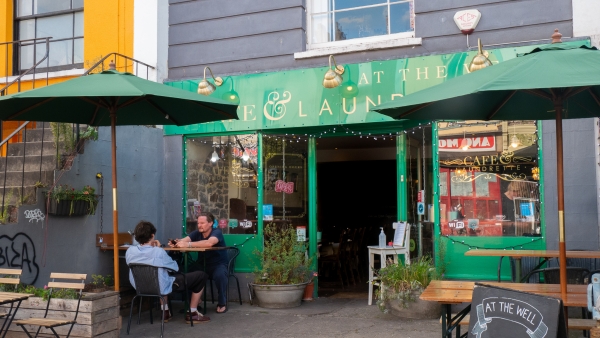
Getting to know At The Well with Lily and Ellen
Posted on: 27 Sep 2022This week, we spoke to Ellen and Lily, 2/3rds of the sisterly trio behind the community-hub cafe-laundrette At The Well - covering collaborative consumption, social wealth, and 'gangnam-style' pancakes.
To kick things off: in your own words, who are you, and what is At The Well?
Ellen:
Ooh-
Lily:
Ah-
[they both laugh]
Ellen:
I’m the eldest, so I’m going to start. I’m Ellen and At The Well was actually my idea – I’m going to claim it!
About, ooh, 12/13 years ago, I was a graduate in Bristol, living just off Cotham Brow. I had a washing machine in my flat, but just hated that drying rack situation – just days and days of laundry just making a mess and not actually getting properly dry.
There’s a laundrette on Cotham Brow and there’s a coffee shop next door – so it just became my little Saturday thing to go and sit in the laundrette. Because it takes an hour and a half to wash, dry, do the whole process, it just bought me a little space on a Saturday, on my own, and I’d take a book or some of my mending or something, and just enjoyed that little routine around it,
The thing I really liked about the laundrette is, because people tended to be on their own, there was no weirdness in the way that there was a bit of a weirdness about being in a cafe on your own, and you’d maybe sit behind your phone or a book. Not in a laundrette, most people do their laundry on their own. So people just struck up conversations, it broke down those social barriers.
But I still had this thing about whether it’s okay to leave my laundry, so rather than sit in the coffee shop next door, I used to bring it back and have it in a takeaway cup. I’d think: “Oh, wouldn’t it be great if there’s was a space where you can do all those things in one space?” Sometimes you have these ideas, and then they go away. Which I fully expected this one to.
We found out there was a couple of cafe laundrettes in Copenhagen, so we did a family holiday to Copenhagen: specifically to go check out these cafe laundrettes.
I think it was the first time we’d been away as a family, so it was really significant to actually go on this weekend holiday. We just sat in the cafe-laundrette in Copenhagen, and we’d sort of move between them so we didn’t look too suspicious, and they didn’t start asking questions about what we were doing there…
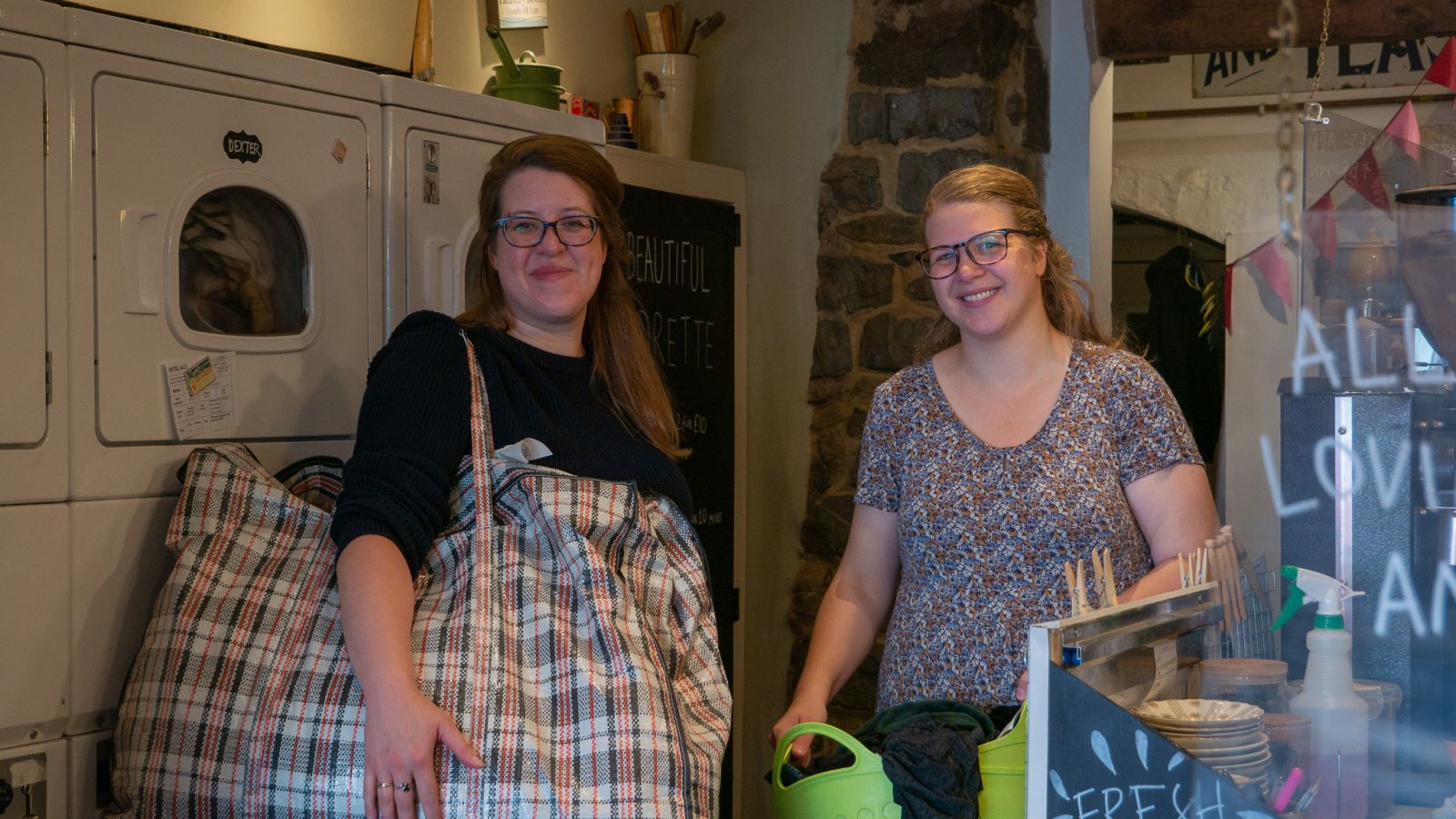
Ellen (left) and Lily (right), 2/3rds of the sororal team behind At The Well.
Did you bring washing?
No! No, we just sat and… we played their board games, obviously we bought food and drinks. It was really nice. We didn’t actually see that many people doing their laundry in Copenhagen. It was actually more about the cafe in that particular space.
In fact, in Copenhagen, and in Denmark generally, there’s a much bigger culture of taking your laundry somewhere, and laundry being a communal, shared facility.
I had to write a business plan for a piece of university coursework – I’d gone back to studying – so I wrote it about this hypothetical cafe-laundrette.
Prior to that, all three of us had been out to Zambia, and one of the things that struck me is a real sense of community associated with having to live quite a lot of their lives outside of their homes.
The nature of the poverty, and the fact that people didn’t have electricity within their homes, the homes were very dark. You do your whole life in that culture outside, you cook outside your house, you do your laundry outside – lots of people sitting with their neighbours doing their laundry.
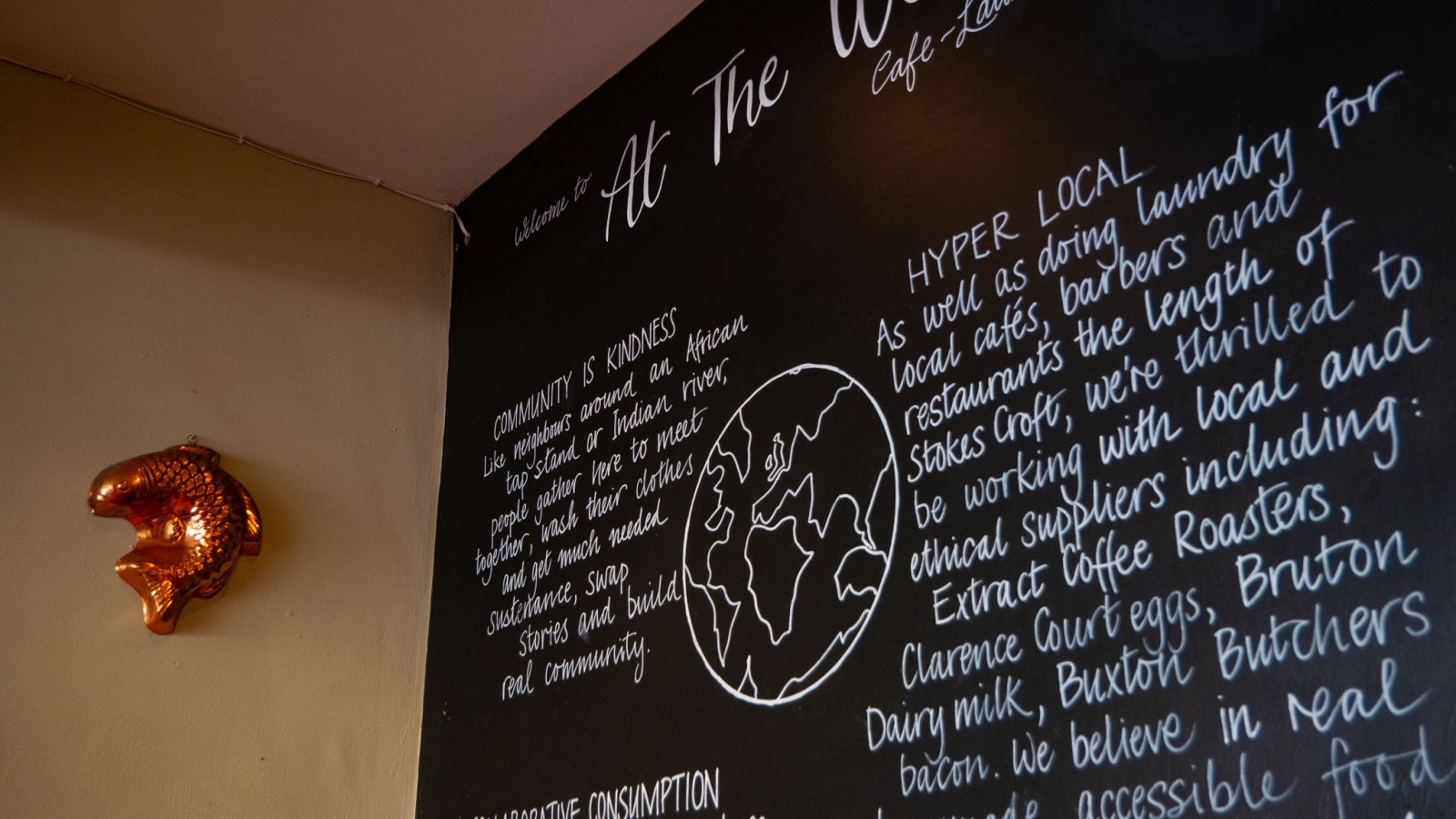
It’s a very close sense of community, and that’s where the name At The Well came from: the sense that the well in those communities was really just a gathering place. We don’t have that in our culture, we go out to work, we come home, we close the curtains. A lot of people don’t even know who their neighbours are.
We tend to think of that as a very poor culture and us as a wealthy culture, but that’s purely monetary, that’s not everything. I came back and thought “goodness, we are really poor in a kind of social way”.
I’m a sustainability consultant as well. I was doing a lot of thinking around material resources, and reading a lot about collaborative consumption: the idea of sharing things you don’t actually need to own yourself.
A washing machine is quite often pulled up as an example; some families might run their washing machine every day – but for a lot of people your washing machine might go on once a week, and the rest of the time its just sort of sat there taking up space.
Lots of ideas and thinking came together – a cafe-laundrette would answer all of these things in one – or you know, might. It was just an experiment, we honestly didn’t know whether it would work.
The thing that sealed the deal of “OK, we’re doing it”, was this particular building used to be the site of Bristol’s first coin-op laundrette. I learned that it was derelict, and I thought “That would be a cool story, if we’re going to open a cafe-laundrette, to open it in what was the site of the first laundrette in Bristol. I wonder who owns it?”
We looked it up on the land registry to try and find out the owner of this property, and during that time, during the process of getting the address of somebody up north that I was going to write to...Someone we knew happened to buy the building.
We happened to have this conversation with someone and he said “Yeah, my dad’s just bought the building. Do you want to come in and see it?”
I was like “Uh...yeah?!”
Lily:
It was that moment that we all looked around this...this absolutely horrific building.
Ellen:
Oh yeah, it was a state.
Lily:
It had nothing, it had no ceiling-
Ellen:
There’d been a fire.
Lily:
No electricity, nothing, everything was black.
We just got so...excited! We just couldn’t wait! In fact, we were there, at the time, stripping wallpaper! Saying “Ah, we’ll have it!”.
But because we were going to change it from a laundrette – it had planning to be laundrette, but it didn’t have planning to be a cafe-laundrette, that doesn’t exist. We had to pay some money – I think it was £500 – we paid that, and we thought...there’s now no going back.
Ellen:
We’re committed now.
Lily:
That was, probably, the most expensive £500 we’ve ever spent.
None of us had any experience in business at all, no one had worked in a cafe. We had absolutely no idea what we were doing and we just said “yes, we’ll take it, we’ll take the building, we’ll do the work”.
Ellen:
It was a 9-month renovation project in the space, we were in here every day doing stuff and recruiting lots of friends – lots of people helped. Which is partially why it’s so nice: I look around this space and think: my neighbour did this and my housemate did that.
That’s been foundational to how we’ve operated ever since really. It’s important to it feeling like a community asset and people feeling like they were part of it – that was always the vision really.
I know you guys had your tenth birthday recently – how does that feel?
Ellen:
It was great. It’s been such a rough few years, through COVID...that was particularly tough. Even before that, we were new – we were doing something new. I think it’s an ongoing challenge to communicate we are actually a laundrette and we actually have washing machines.
People still come in and think it’s maybe a theme. Although, once people realise they’re like “I get it!” or “Oh, I thought about doing this”. It’s so instant...as a concept, people instantly go like...
Lily:
“That makes so much sense.”
Ellen:
Which is nice. So once we’ve actually communicated what we do, people get it.
Lily:
But it’s very surreal, that ten years have passed. We still feel very much like beginners.
A huge privilege, that’s what it feels like; that we’ve seen such an interesting slice of the community here, and that we’ve been part of building it.
Ellen:
Stokes Croft has changed a lot, in those ten years. We were very much on our own out here. The Tesco riot, for example, was during the time we were renovating this.
Now Stokes Croft is a breakfast destination – which is great, and in reality that’s good for all of us, but we didn’t really have competition in the same way, that we do now. Or friends!
We wash tea-towels, and aprons for all the cafes locally. I speak about competition, but it’s not really like that at all. We tend to know all the businesses round here – we’ve borrowed bags of coffee from each other, and till rolls, you know...
It’s another extension of that sense of community?
Yeah! It’s another extension of that sense of community, which is nice.
We’ve talked a lot about the laundrette, you’re also a cafe – what’s your favourite thing on the menu?
Lily:
We’ve got two things on the menu which are very similar, our “Osaka-style pancakes” and our “Gangnam-style pancakes”, which are both absolutely delicious – well done Ellen (she put those on).
The really nice thing about our menu is it’s really wacky, and that’s always been the case since we opened; we’ve always had a really bizarre collection of things we wanted to eat, or things we wanted to try.
The nice thing about being a cafe-laundrette, is because you’re already an odd combination, somehow you can get away a bit more with odd foods.
If you were Mayor of Bristol for a day – what would you do?
Ellen:
There are a number of small businesses in Bristol. I think it would be really interesting to approach those people and say “there’s something lacking in this area, and there’s something you’ve got that we want to reproduce – so we’re going to support you to create the conditions to do that.” That kind of replication of where things are actually working, and matching all the people up and saying “let’s replicate that, because it needs the something you’re doing well”.
Lily:
Sounds good to me.
Sounds good to us too, Lily.
At The Well are at the top of Stokes Croft. Their website is here - where you can find all their social media too.
Read more:
-
Inter-brew: Getting to know Little Martha Brewing
Article by:

Patrick is a filmmaker with so much Bristol in his blood the white blood cells are graffiti'd. Educated at the Northern Film School in Leeds, he’s returned home to be a Videographer and Reviewer for 365Bristol and BARBI. When he’s not messing about with cameras, he enjoys playing guitar, spending far too much time on tabletop RPGs, and being an awful snob about cider. Have a look at his work here, or get in touch at patrickb@365bristol.com.